
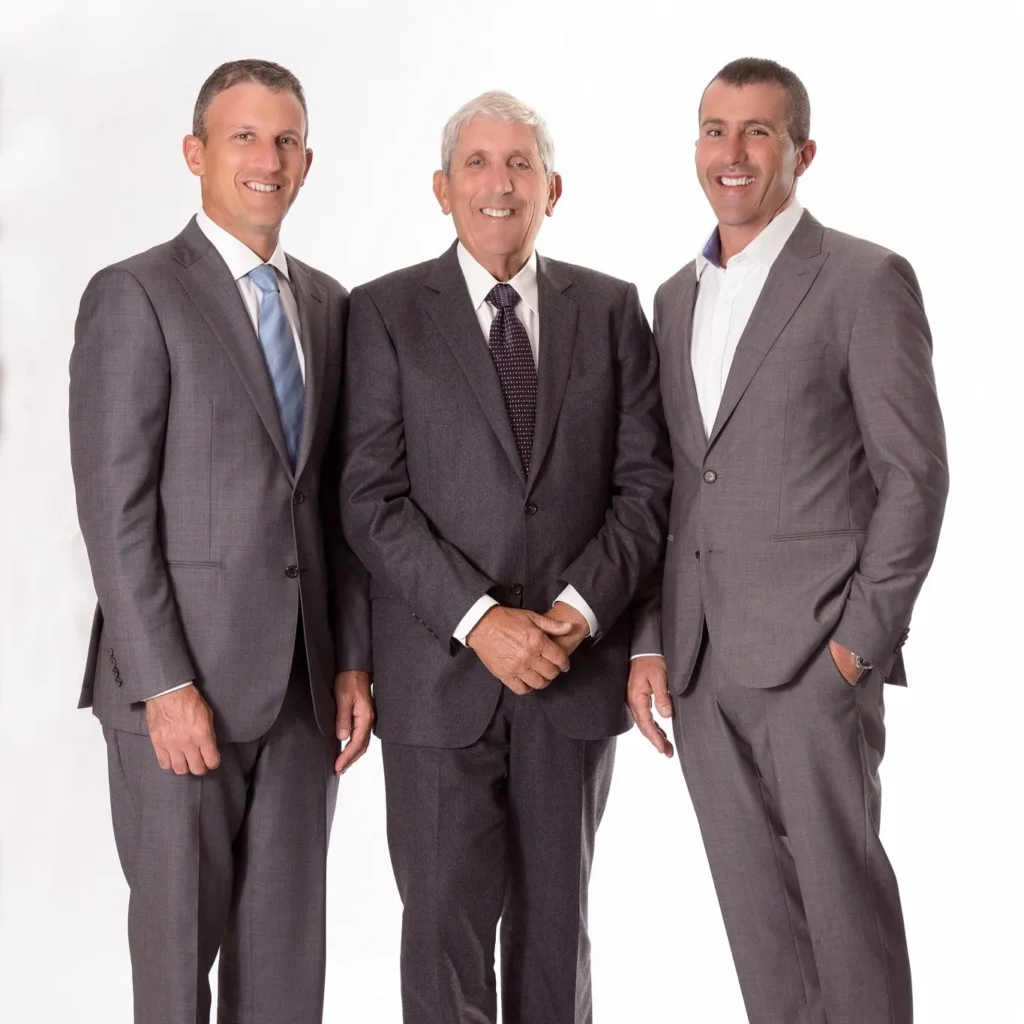
Family-owned real estate firm made Detroit investments at key moments
March 16, 2026
It has been nearly three years since the passing of Farbman Group cofounder Burt Farbman at age 80, although for his two adult sons, their transition to running the family’s metro Detroit-based real estate services company actually began at the turn
of the century.
Andy and David Farbman still clearly remember the August day in 2000 when their father surprised them with the news he was stepping away from day-to-day operations and putting them in charge.
“Our dad kind of gave us this test run for 24 years,” Andy Farbman, the company’s CEO, recalled in an interview this month.
As Farbman Group this year marks the 50th anniversary of its founding, the brothers are drawing on fundamental business lessons they learned from their dad as they navigate the still-evolving post-pandemic market for commercial space, a rise in building receiverships and uncertainties about what AI, or artificial intelligence, ultimately will mean for real estate.
Headquartered in Farmington Hills, the company has weathered the many ups and downs of the real estate business cycle in the decades since Burt Farbman and business partner Lee Stein started the firm in 1976. (Stein died in 1987 at age 52.)
“We’ve seen four major downturns of the real estate market through the history of our company,” Andy Farbman said, “and every single one of them, when you get through them on the other side, you’re stronger, you’re more lean, you’re more focused.”
Today, Farbman Group manages over 35 million square feet of real estate and has a presence in seven states besides Michigan, including Ohio, Illinois and Florida. The company has about 200 employees and owns and manages commercial, residential and industrial properties, and also does development and redevelopment.
The company has eight subsidiary businesses that include brokerage platform NAI Farbman, the commercial construction firm Huntington Construction Co. and a recently started HVAC and plumbing business known as Apex Mechanical Solutions.
It also has a busy receivership business, one that the brothers credit with helping to keep revenue coming in the door during the industry’s more challenging periods, such as during the Great Recession.
When an owner of a building starts missing loan payments, the lender may ask a court to appoint a receiver to manage the property and potentially prepare it for a sale.
“2008 was a really, really tough time in the Wall Street markets, in the capital markets side of the real estate world,” Andy Farbman said. “Thankfully, my dad had this infrastructure and this amazing receivership business that acted as a hedge for our company — that literally kept us working, kept us focused.”
“If we had not had that business at that moment, life would have looked a little different,” he added. “And so it really kept us in an ability to operate, to profit, to fund our other investments.”
Lately, their receivership business has gotten busy again. Not because the economy is experiencing another period of high distress, Andy Farbman said, but rather because “lenders are being more decisive right now” and opting to take action on buildings that are struggling.
“Our portfolio has actually grown through this time,” he said, “and that has more to do probably with the Wall Street corrections that are going on — and that is the debt corrections, the valuation corrections that are going on in the marketplace.”
COVID-19 and the surge in popularity of remote office work did negatively impact occupancy at many commercial buildings.
More recently, some companies have pointed to their investments in AI as reasons why they anticipate reducing headcount. The likely impact of AI on the commercial real estate market, however, is still an open question.
“The post-pandemic issues have created additional challenges,” Andy Farbman said, “where certain types of real estate became more valuable and others less valuable. And office is definitely one of those sectors where if you owned run-of-the mill average office space in an average location, your property was going to be worth less than what it was when we started the pandemic.”
Sunday morning drives
The Farbman brothers fondly recall awakening early on Sunday mornings when they were growing up and accompanying their father on long drives throughout the city of Detroit.
“He would always tell us that the only way we can ever say Michigan has made a comeback is if Detroit actually makes a comeback,” David Farbman said. “Otherwise, Michigan is lost.”
The Farbman Group has a history of making investments in the city at key moments.
One such investment helped to preserve the ornate Old Wayne County Building at 600 Randolph in downtown.
In 1984, a partnership headed by the elder Farbman bought the 1902 Beaux Arts landmark in a purchase/leaseback deal and proceeded with sorely needed renovations. At the time, Wayne County was still using the building for courtrooms and executive offices.
The county stayed in the historic building until 2009, when it moved offices to the nearby Guardian Building. The Farbman partnership sold the building in 2014 to a New York firm, which has since continued to maintain the building, even as it remains vacant.
Burt Farbman also helped in the planning and implementation of the 1990s land acquisition effort for construction of Comerica Park and Ford Field in downtown.
And the company played a role, alongside General Motors and other partners, in developing the Clark Street Technology Park in southwest Detroit on the former site of a Cadillac Motor Division headquarters and assembly plant.
Farbman Group also pioneered a new generation of trendy downtown Detroit housing with its redevelopment in the early 2000s of three historic adjoining buildings between 1424 and 1448 Woodward, a block north of the Hudson’s site.
Known as the Lofts at Woodward Center, the development created 61 apartments in the buildings’ upper floors. The firm sold the buildings in 2016 to Dan Gilbert’s Bedrock real estate firm. Today, the apartments are still there and the buildings’ ground-floor retail spaces are filled with the newly opened Detroit Apple Store and Rihanna’s Savage X Fenty store.
The Farbman Group also is a past owner of the famous Fisher Building in New Center.
The company bought the Art Deco masterpiece in 2001 and two years later acquired a newer neighboring office and medical building, New Center One. It spent a considerable sum maintaining the elegant Fisher Building and held onto it until the mid-2010s. Today the building is owned by Michigan State University.
“It’s a true iconic building that matters to the city,” Andy Farbman said. “And when you operate a building like that, it comes with a responsibility.”
Guiding principles still followed
The brothers said they continued to draw on the wisdom and business lessons that their father imparted.
“My brother and I are really big on quoting my dad whenever one of us calls the other in the middle of the night with some sort of stress,” Andy Farbman said.
One of Burt Farbman’s guiding principles in real estate was to “make all your money on the buy.”
For David Farbman, the aphorism means that “if you buy right and you have the right basis and you have staying power,” in time, the property purchase is bound to work out.
“I will tell you that ‘Make all your money on the buy’ has paid off 100% of the time for us,” he said.
Another Burt Farbman principle was “grow with your clients.”
“If you have partners, if you have big clients — grow with those clients, don’t run out way ahead of them,” explained David Farbman. “Grow just as they are anticipating the need or they have the need, and that’s how you expand footprint. If you do it that way, you don’t get in trouble.”
Although still in their 50s, the Farbman brothers have been giving more thought to the future of the family business. Andy Farbman is a father to three daughters and David Farbman has four sons.
“We’re trying to figure out whether we can convince two or three of these seven very capable folks to step into these shoes,” Andy Farbman said. “David and I both feel responsibility as caretakers of a business that’s been around for 50 years. We’re trying to figure out ‘What does the next generation look like?’ ”
Related Posts

How to Evaluate Commercial Real Estate Investment Value: A Buyer's Guide
Blog Post | July 31, 2026
How to Evaluate Commercial Real Estate Investment Value: A Buyer’s Guide Commercial real estate investment offers durable income, long-term appreciation potential, and meaningful portfolio diversification. But those outcomes depend entirely...
Read More
50 Years Strong - From Midwest Roots to Global Expertise
Blog Post | April 30, 2026
#cheersto50years #anniversary #fivedecades #midwestroots #naifarbman #farbmangroup #50thanniversary #50yearsinbusiness #michiganbusiness
Read More
Farbman Group Grows Family Of Organizations With ClimateGuard Pro
Blog Post | April 7, 2026
Click Here for Article The newly-formed organization reflects another step forward in the firm’s commitment to innovation, safety and proactive property management Farbman Group, a full-service commercial real estate firm, today...
Read More